
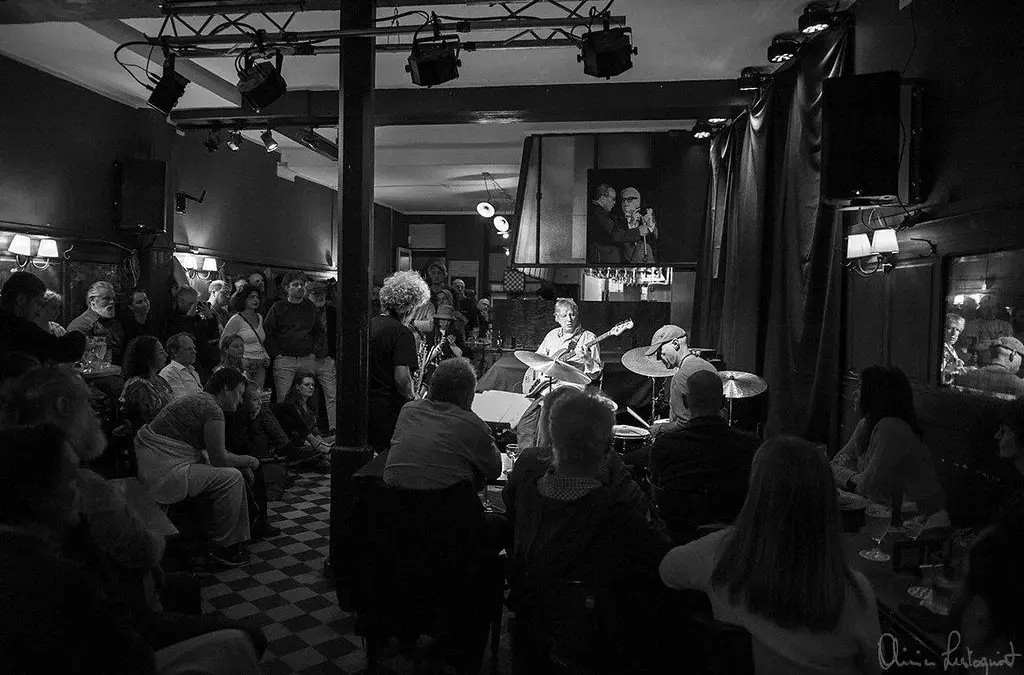
Toot’s Jazz Club is the latest home for jazz in Brussels, opening in May this year. On my recent trip to Europe in June, I had little time for music, but was happy to have experienced an evening there, watching the Basile Rahola Quartet.
The venue is located right in the heart of the city, alongside the opulent Grand-Place square, a major tourist attraction in the city centre. However Toots is a humble but serious music venue, and from the first night being there, it was evident by the amount of musicians hanging around and showing up for the jam, that the venue is quickly becoming a favourite in the city. There was a palpable buzz by the excitement of having musicians hang around waiting to play at the jam, many of whom were excited to talk about their connections to artists on the South African jazz scene like Nduduzo Makhathini, Kesivan Naidoo and Linda Sikhakhane.
Founder Joachim Caffonnette is also a pianist and composer, which makes all the difference in how a venue works. We had a chat to discuss what it takes to run a venue in Brussels, considering how challenging it is in South Africa to keep music venues and specifically jazz venues afloat.
In South Africa, there are no government subsidised music venues. This has made the work of Concerts SA – a local platform – very important in helping to support venues. Research from a 2013 project called Songlines, examined the need for live music venues. As a result, Concerts SA grew from this research to help encourage live music circuits, of which many had disappeared by 2010, leaving musicians with few spaces to perform. Since 2013, they have supported over 2000 venues in the Southern African region, which allows for concerts to take place professionally but also to ensure spaces for musicians stay open.
Subsidies were created to enable artists to tour around the southern African region, he says and as a result, James French from Concerts SA says, “Music venues benefit from these subsidies by being able to access artists from other parts of the region with diminished costs in relation to the musicians’ travel, accommodation and even musicians’ fees. The venues can also prove a diversity in their programming, and with proper marketing can develop broader audiences for their spaces.” Most recently, A new round of funding from the Jobs Fund, via the Festival Enterprise Catalyst, has just been awarded and the beneficiaries have just begun to tour in South Africa.
Research has shown that music venues in South Africa struggle to survive, and many often close for unexpected reasons, which French says are often ‘structural’. In Europe, venues will offer experience these same issues – the difference is that there is a lot more support for artists and culture through various platforms other than the government.
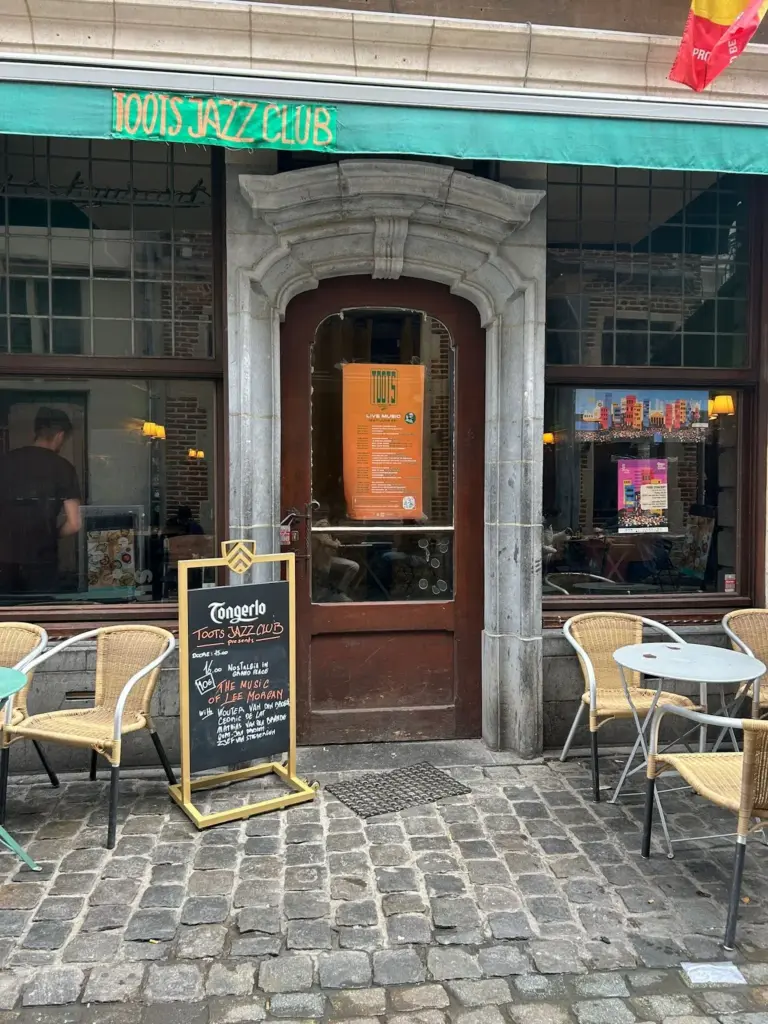
Becoming Toots Jazz Club
Before working in music venues, Caffonnette had worked as a musician for years. He studied at the Conservatory and toured as a jazz musician, composer and often worked in theatre. Before Covid19 pandemic, he was touring roughly eight months of the year, and now that isn’t viable due to his commitment at the venue. “I have a family history of being really involved in defending the rights of the artists. My mother is really involved in that. It’s always been important to not be just an artist, to also act for my fellow musicians and to defend the rights of musicians,” he says.
He joined the board of Les Lundis d’Hortense in 2015 – the oldest jazz musician association in Belgium active since 1972 – a non-profit association of musicians working to promote Belgian jazz, which receives financial support from the Ministry of Culture of the Wallonia-Brussels Federation.
After two years there, he was appointed president of the board, a role he carried until 2021. “In three years, I changed a lot there and tried to have a democratic way of working. They do three great activities: a summer camp; a weekly concert in a club called The Jazz Station; and lastly they support a jazz tour.” Over 10 bands are selected each year, and have a month tour in various venues in Brussels, roughly 10-18 gigs per band. “The particularity was that we will select the bands blindfold, so there are 18 musicians on the board, and we all listen blindfolded to more than 200 applicants, and then we would choose. The bands that have the most votes will get a tour. I worked a lot on that, and we also relaunched a website called Jazz in Belgium to compile what’s happening in jazz in Belgium.”
“I always dreamt of having a jazz club”, Caffonette says. At the time, he had been playing at a venue called Sounds for gigs and jams. In 2021, he was approached by the new owner there to run the programming. Assembling a team, he worked to relaunch the venue which proved to be very popular, until June 2024.
After that, not one to rest, Caffonnette started looking around the city for a space. “I was already looking for a new venue, but it wasn’t easy. I was lucky enough to get in touch with the University of Brussels because I knew that they had a building near the Grand Place.” He wrote to them and the process took a few months, but eventually the university allowed him to use the building as long as no renovations were done. They said he could use the space and take care of the building, as long as it was used for something towards culture – “that was the most important thing they asked”.
He then got in touch with the family of the famous Belgian jazz harmonica player, Toots Thielemans, and asked for permission for the name for the venue and “to do a proper jazz club and have something that really feels like home for musicians. I wanted to do something that’s close to the people and still affordable.”
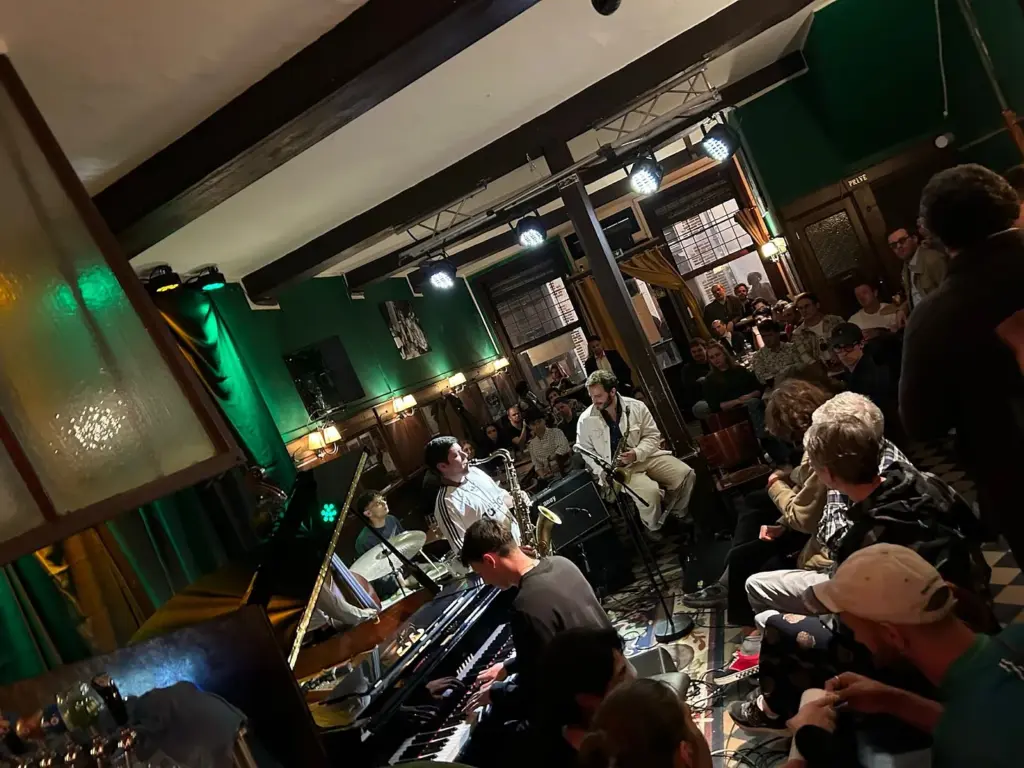
From the get go, the venue set out as a serious jazz listening space, despite its proximity to the tourist hub. It officially opened on 15 May this year. The space was quickly set-up because Caffonnette had a lot of the material from his time working in music. The piano was gifted as a loan to him by a jazz fan who said, “‘I’m going to buy it, it’s going to be my piano, but you can use it at the club’, so that’s how we end up with a really great piano and that makes all the difference.”
Music venues don’t get subsidies from the Belgian government by default. You first have to prove your business works over a three year period. Having someone in his team that knew their way around applying to institutions helped get different kinds of support for three years. “But after three years, when you’ve been running a venue or a festival and you can prove it works, you can apply for structural subsidies. We did that, and now it’s been two years since we have funding from the French-speaking government. It’s not much, but without that, we couldn’t do it.”
The venue hosts roughly 11 events a week – a jam session on Wednesday; gig on Thursday, two shows on Friday and a late-jam; two shows on Saturday and a late jam. Moving forward they will add a Sunday night show for young bands and solo piano on Thursday after work.
Thus far, the money at the door covers the musicians fee. “So far, we managed to do a bit of profit on the door. The bar has to pay for itself – salaries, rent and charges .The real problem that venues like this have is that every extra cost of production is not covered, so we need to pay for communication and administration. That’s why I do so much by myself.”
Moving forward, another subsidy would be applied to cover jobs like communication, administration and management.” In addition he secured sponsorship contracts with brewers and other businesses, donations on the websites, gift cards and merchandise to find the extra money to manage the club, apart from paying musicians and the normal costs.
Busy nights at the venue make sure that quieter evenings are covered, so the finances balance out each month. The venue also hosts a summer residency series for bands, and they are able to use the venue to rehearse and practice new repertoire.
In his time curating line-ups at Sounds and also working as a touring musician, Caffonnette has amassed hundreds of music connections worldwide. In terms of curating line-ups he says, “The big problem is there are so few venues and so many bands that want to play in Europe. On average, I receive like 30 – 40 client requests a week.” He tries to programme a range of music from modern jazz to old Dixieland jazz, trying to have a good balance with locals and bands from abroad. Once or twice a month he has big touring artists.
“I try to have more women leaders on stage. That’s a real issue, because there are so few applying. There are really not many women musicians playing in Europe. It’s changing with the younger generation. Next month I managed to have two weeks – one with a singer, another one with a female saxophone player – we’re getting there. But my goal is by 2028 I want to be able to have 35 to 40% of women on stage. It’s something I really care about, and I’m really trying to have more women playing in the club.Having diversity among players is also another thing I always have on my mind. I try to also have all styles of jazz coming. I also try to give young musicians a chance.” He continues, “It’s also important to have a pool of musicians that are like the house band. I can also trust them for recommendations of other artists.”
Caffonnette says the experience has been rewarding so far. “It’s been a dream of mine. Of course, I’m working like crazy.I work around 80 to 90 hours a week. I have a lot on my plate. But through my experience at the Sounds before that, I learnt so much, how to be more efficient and think business wise. I managed to do a proper business plan and to convince people to invest and find the money and as a musician, it’s very rewarding. Because it’s a dream come true, and people are really very pleased with the place.”
“Being a musician running a club means you can really welcome the musicians the proper way that you wanted to be welcomed when you play somewhere, and that’s what I try to do. My crew get that. But for me, it’s really important that everybody feels at home – the musicians, but also the audience and also the people I work with. That’s what makes the place successful, because it’s home for everybody. “
Caffonnette’s advocacy for the arts is inspired by his family. His mother is a famous theatre actor and author known for her work in ‘object theatre’ – a book was recently published about her life. “She’s been touring the whole world and still touring a lot. She’s 73 now. I grew up with theater. I was touring with her when I was a kid. Sometimes she would play 200 shows a year. I remember when I was a kid we did a three month tour in Canada, taking a plane every two days…But my mother also was really involved in defending the rights of actors.She worked to bring theater to schools and bring schools to theaters. I grew up in that environment of active artists.” His father is an artist and brother a ballet dancer, so becoming a musician was a natural course for him.
“I always wanted to be a musician, and always knew that at some point I’m also a leader. I want to act for the community. It’s important… I had to do something that was really down to earth. And doing this really makes a difference. I can feel the difference that I’m making, that’s why I’m doing it, and that’s why I love this so much. Because I really can say that I’m really helping the community, and I can see it every night, that it actually works.”