Collaboration is at the centre of a partnership between the biggest arts festivals in South Africa. In September 2024, The Festival Enterprise Catalyst (FEC) launched as a platform for festivals to work together. The partnership is between The National Arts Festival, KKNK, NATi, Aardklop, Woordfees, Suidoosterfees and Concerts SA – major arts festivals that run throughout the year in South Africa in various locations. The partnership includes a shared investment of R20 million between the festivals and the Job Fund to create meaningful work, support new productions, encourage touring and sustain a network of live performances around the country.
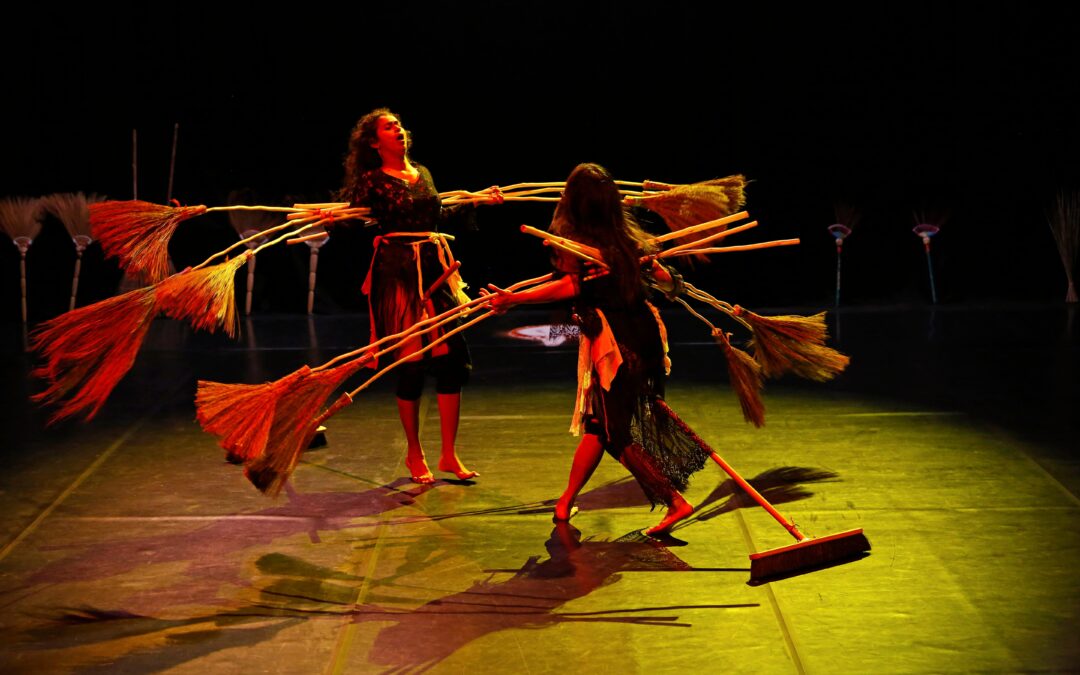
This year’s National Arts Festival (NAF) featured four new works supported by the platform.
CEO of the NAF, Monica Newton explains that the festival came about through a meeting with the Tribuo Fund – hosted with artists and other cultural facilitators – in June 2023 to work out sector challenges and plans. “I was on a panel with the other festivals and there were artists in the room challenging the festivals saying, ‘You’re important to the ecosystem, but how you expect new work every time we appear on your stages, is not very helpful’.”
The festivals were indeed challenged by this statement suggesting that commissions of work don’t result in artists developing repertoire and a sustainable income. Newton explains that when commissioning work, the costs are very high; but if that work tours, especially in a single year or cycle without having to change cast members, then there is a lot less expense.
Around the same time of this conversation, there was a round of applications for the Jobs Fund – created in 2011 by the National Treasury to address unemployment in South Africa, which stands at 32.9% as of the latest poll. “The Jobs Fund is unusual in that anything that it invests in, its beneficiaries also invest,” Newton explains. It is a challenge fund with a minimum investment of R5 million from all participants. This set off a process of figuring out how festivals could work together to create a circuit of work that would commission new work which could tour between the festivals.The group decided to apply and took three weeks to submit the application, which they say was a very “onerous and complicated” process.
“The first thing was recognizing that we’re not in competition with each other; that we are factors in the same ecosystem, and that we can work together in a variety of ways,” explains Newton. The next step was to look for complementary partners who could invest.
The festivals work as aggregators of value as investment nodes, “If we work together, we have a bigger impact. Fundamentally the aim is jobs, and preferably sequential and continuous jobs as best as we can, although that may not always happen with every production, and every production may not necessarily be right to travel to every festival.”
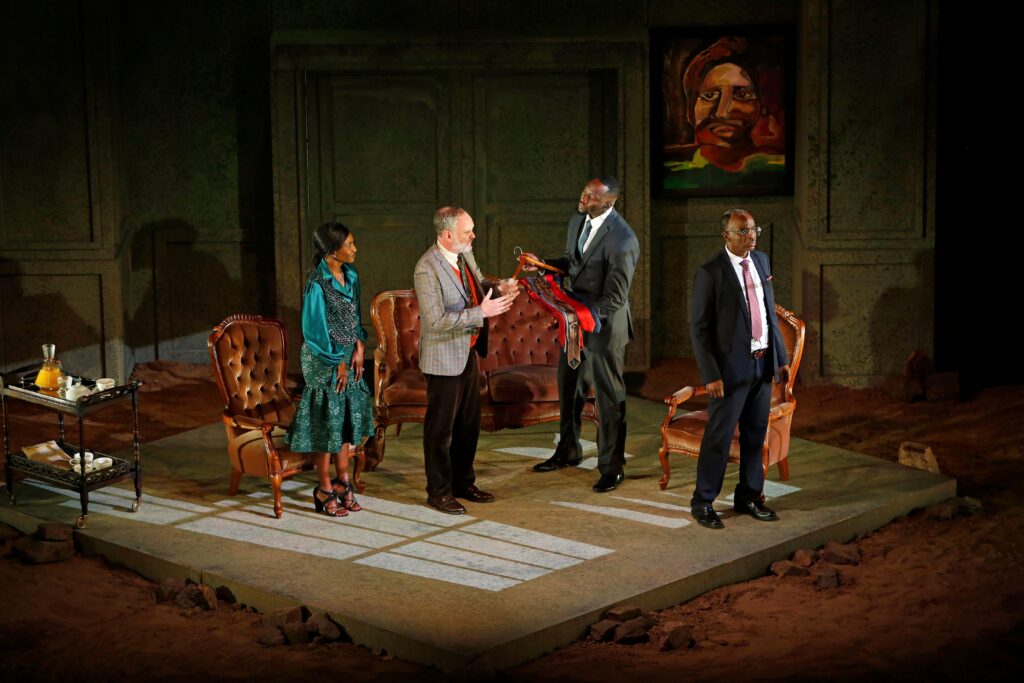
Breakfast with Mugabe directed by 2025 Standard Bank Young Artist for Theatre, Calvin Ratladi. Picture: Mark Wessels.
Building inclusivity in festivals
“We try not to overlap with each other’s dates and we’re really piloting an idea here, and goodness knows, it’s a complicated project.” In its current phase the FEC is still a pilot project, with the hopes of continuing annually.
This is a hopeful moment amidst a devastating set of circumstances for the arts in South Africa. Considering each festival has had to invest money to be a part of the partnership, that does leave out many independent or smaller festivals, especially those black-owned or from low-income areas. How then does the FEC build inclusivity?
The festivals were all required to commit to a certain amount of investment and the Jobs Fund did the same. “We used a window pertaining to entrepreneurship, because we made the argument to say that at the end of the day, these jobs are short term, sometimes informal. We are the original gig economy. Before there was Uber, before there was Mr. Delivery, there was us. And that’s an environment that the Jobs Fund is interested in exploring, which is one of the reasons that they invested in this project.”
“It’s also us understanding differently how enterprises drive our sector; how enterprises create work; what is the kind of investment that they need from all of us to basically create a work and tour a work. Theatre is different from music, is different from comedy is different from dance. There’s a lot of different learning experiences here. At this point, it is a fairly narrow group, but in the future, I think it could open up. The question would just be, how then does that happen?”
The first challenge for the festival is starting something and engaging with a new funder. This required credible partners which were multidisciplinary arts festivals. “I think it is important to note that each of these festivals have gone through their own transformation. Probably KKNK and Woordfees the most obviously so. The other festivals are very understanding of the role that the National Arts Festival plays, because we can program work that almost nobody else can because obviously the basis of our funding, the intention of the festival, for many years has been precisely to be diverse and transformational.”
For the initial round those festivals that could invest were the ones included.
She continues, “Once we’ve tested the model and seen the difficulties of it, and perfected it and go – ‘Here are the lessons; here’s what works and here’s what doesn’t. This is the scale of production that we can support, or this is how touring makes sense’.”
The question returns to what happens to smaller festivals who can’t put money on the table. Newton says that this is a question they will be exploring in thinking about what else can be a point of access to the program in the future aside from money. However for now, they have to see if this model works and if it is worth it for everyone.
New beginnings
Newton says, “What we’re trying to do is emphasize that through collaboration, we can achieve so much more through co-investment. The question is where is the money spent? How do we make the best of it? And critically, how do we keep an ecosystem both functioning but also evolving?”
This ecosystem was never really ever thriving to begin with though – there were always issues of weak policies, difficulties in the economy, competition for audiences, scarce jobs – but “maybe when we get together and deal with these problems, we learn and we get better,” says Newton.
The administrative requirements of the Fund are arduous and new to the group, but Newton says, “We give them their dues. They’re always willing to meet us halfway and to learn different and new ways of working, because we also recognize that the arts funding environment is not going to get any easier and the uncertainties are not going to suddenly resolve themselves.”
What are some positive outcomes so far? Newton says it’s been interesting for the NAF team to attend these festivals and “to actually go and see how how KKNK has evolved; how Suidoosterfees takes over Artscape, how Woordfees is really taking over Stellenbosch and becoming a very, very large festival and also sharing between us the knowledge and experience that we’ve gathered over time.”
Many of these festivals have been around for several decades, so there is a lot of experience between them and room to learn from each other. “How do we share that also, then with smaller festivals, who are needing a little bit of guidance, help, information, experience, financial assistance and some really great work, and can change how their programs are perceived nationally and internationally.”
The most important focus for the FEC has been to prove to the Treasury that they are capable of administering the project and making sure they achieve its targets; imagining works that are commissioned to have life beyond their first moment and fairly quickly is what they’re aiming for. And proving to the Jobs Fund that jobs have been created and that this venture is worth the time and effort for everyone involved.
All too often we find ourselves complaining about the arts, but this is a step in the right direction to work collectively. As Newton concedes, “It might not be the solution to everything, but it is about choosing to do something different; being a bit of an antidote to the statement that everything’s just not working.”